Voice AI with Low Latency: Challenges & Breakthroughs for Telecom‑Grade Agents
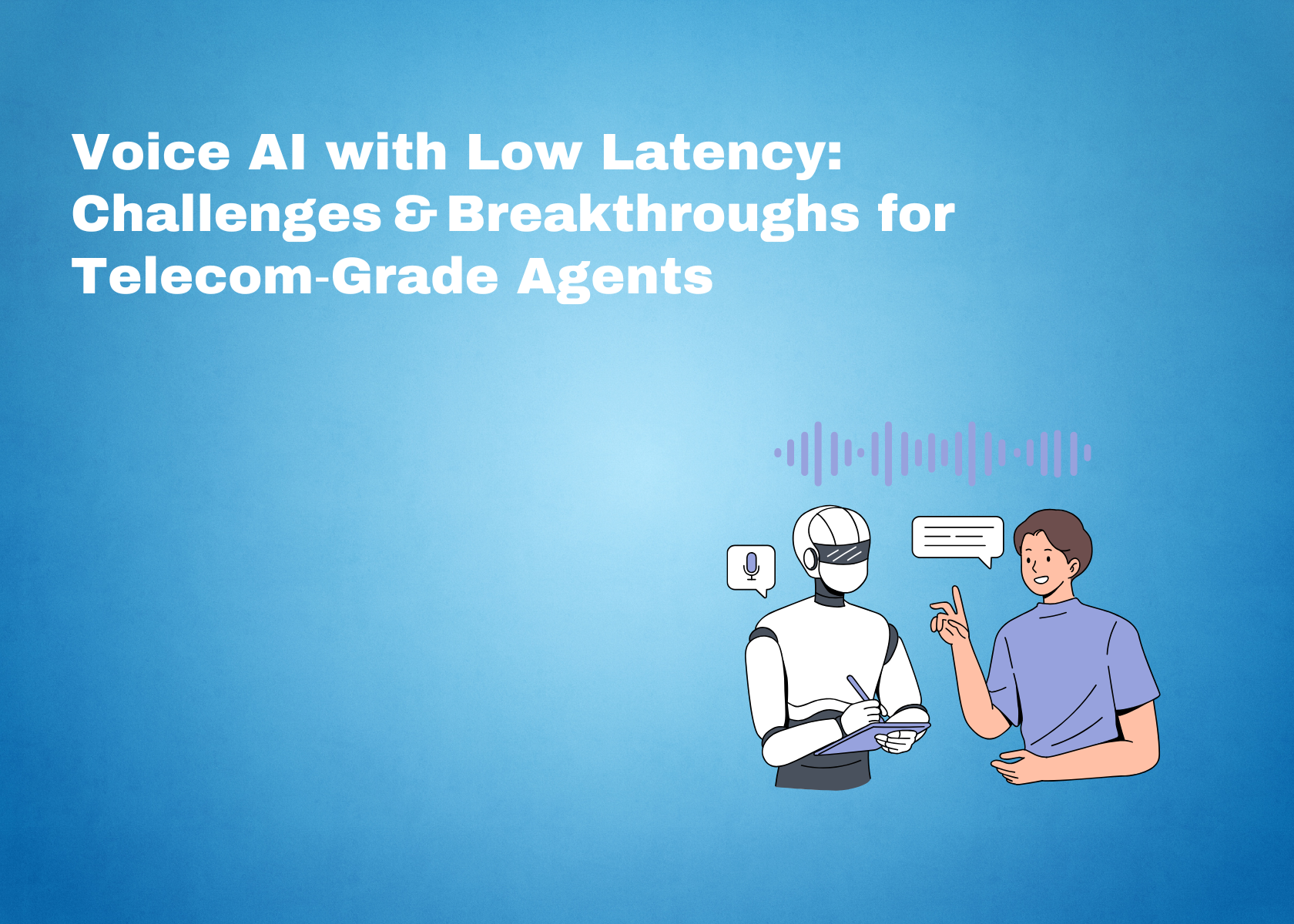
Imagine this: a customer calls in, asks a simple question—and hears the AI agent wait. A pause of more than one second and suddenly it feels robotic, off‑key; worse, the customer hangs up. In voice interactions, timing isn’t just nice to have—it’s the difference between smooth engagement and frustrated disconnect. According to one telecom study, delays over 300–500 ms already begin to degrade the conversational experience.
For telecom‑grade agents servicing thousands of minutes per day, each extra millisecond is a cost. Building a voice AI system that delivers sub-second response times, while maintaining accuracy, context and reliability, has become a strategic imperative.
Why Latency Matters (and Why It’s Hard)
Real‑time voice interactions demand low latency because human conversation flows swiftly—we expect responses inside a few hundred milliseconds. Anything slower breaks the illusion of a natural exchange.
Here’s why achieving it is so challenging:
- Balancing speed vs quality: Accelerating response time can degrade transcription or language understanding accuracy.
- Network & infrastructure hops: Each stage—telephony provider, cloud ASR, LLM reasoning, TTS—adds round-trip delay.
- Traffic surges & scale: Under heavy call volumes, latency spikes unless infrastructure is engineered for concurrency and resilience.
- Complex models & workflows: Voice agents increasingly involve large-language models, retrieval, context management—all adding processing time.
- Legacy telephony and global variability: Network conditions and local infrastructure affect latency heavily.
What Telecom‑Grade Low‑Latency Voice AI Looks Like
A low-latency voice AI pipeline must execute: streaming speech-to-text (ASR) → contextual reasoning → text-to-speech (TTS)—in under ~500 ms, ideally under ~300 ms for seamless UX.
Example workflow:
- Customer speaks: “My service is still out.”
- Streaming ASR converts while user is speaking, passes to reasoning engine with context.
- Agent integrates account data, network alerts, prior service history.
- Agent produces response: “I see there’s an outage in your area—would you like me to escalate or schedule repair now?”
- TTS generates voice and plays it within <500 ms of speech end.
Behind this is telco-grade infrastructure: colocated media servers, PoPs near carriers, minimised network hops, and model engineering for latency.
Key Features & Business Benefits
Features:
- Streaming inference (ASR & TTS) tuned for low latency
- Edge or regional deployment of AI pipelines
- Model optimisation (quantised LLMs, caching, pre-warm)
- Real-time context/handoff to human agents
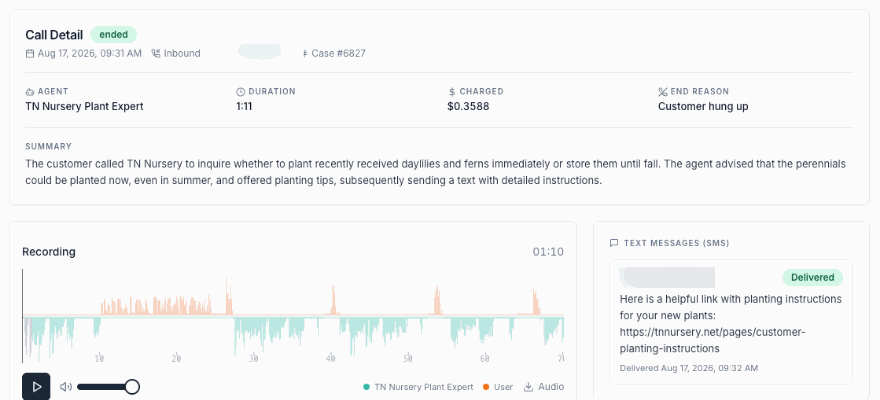
- Monitoring & latency benchmarking
Business benefits:
- Reduced call-handling time & higher throughput
- Improved customer experience & CSAT
- Cost savings & scalability
- Competitive differentiation
- Reduced escalations & smoother handovers
How to Deploy (& Overcome the Hurdles)
- Assess latency end-to-end: Test live PSTN calls and measure round-trip time.
- Choose infrastructure wisely: Use co-located media servers and direct peering.
- Optimise models: Quantised LLMs, streaming ASR engines focused on latency.
- Segment use-cases: Begin with high-volume, lower-complexity voice flows.
- Ensure continuity & fallback: Hybrid human + AI design for smooth escalation.
- Monitor performance & voice UX: p95/p99 latency, abandonment rates, CSAT.
- Govern & comply: Ensure regulatory compliance to prevent indirect latency issues.
Measuring Success & Continuous Improvement
Metrics:
- End-to-end response latency
- Call handle time (AHT)
- Drop-off/abandonment rate
- CSAT/NPS for voice interactions
- Escalation rate
- AI vs human throughput
Continuous improvement:
- A/B test latency-optimized models and infrastructure
- Analyze latency bottlenecks in ASR, network, or TTS
- Refine workflows using real conversation logs
- Monitor sentiment in voice calls
- Extend to proactive calls while maintaining low latency
Ready, Set, Lead Your Voice AI Future
Slow, laggy voice agents feel robotic. Ultra-responsive agents, by contrast, sound human, fluid, and efficient. If your organisation is still relying on sluggish IVRs or text-only bots, now is the time to adopt voice AI infrastructure engineered for low latency, scale, and enterprise readiness.
Start by picking one high-volume voice flow (installation update, billing inquiry, service outage), benchmark its current latency, and pilot a low-latency voice agent stack. Measure improvements and scale out.
For a hands-on demo or to see real-world AI agent success:
- Book a Demo with Klink.Cloud
- How Shopify Stores Use KAI AI Agent to Automate 80% of Customer Inquiries
- From Chatbot to Revenue Engine: KAI AI Agent for Shopify Explained
FAQ
What latency target should we aim for?
For natural voice interactions, <500 ms is ideal; <300 ms is best-in-class. Delays over 1 s risk hang-ups.
Does faster always mean worse accuracy?
Not necessarily, but trade-offs may exist. Optimisation and streaming inference balance latency and accuracy.
Which channel should voice AI integrate with first?
High-volume voice flows (billing, service-status calls) are ideal for pilots.
What’s the biggest hidden cost?
Under-engineering infrastructure—network hops, distant cloud regions, legacy telephony—causes latency spikes, customer frustration, and reduced ROI.
By tackling latency head-on and deploying a robust voice AI stack, organizations can turn voice agents into seamless, human-like, business-driving tools.