
The Future of Contact Centers: Why AI Agents Will Replace 70% of Manual Work

AI is transforming contact centers by automating up to 70% of repetitive tasks. This includes activities like answering common questions, routing inquiries, and handling data entry. As a result, human agents can focus on complex customer needs, reducing burnout and improving service quality.
Key Takeaways:
- AI handles routine tasks: Examples include identity verification, call routing, and retrieving customer information.
- Improved efficiency: AI tools like chatbots, voice assistants, and predictive analytics reduce wait times and enhance customer interactions.
- Cost savings: Automating manual work cuts operational costs and minimizes high agent turnover expenses.
- 24/7 availability: AI ensures round-the-clock support across multiple channels, meeting modern customer expectations.
Platforms like klink.cloud simplify AI integration by unifying communication channels, CRM data, and workflows. This ensures smoother operations and better customer experiences. While AI takes care of repetitive tasks, human agents can focus on high-value interactions, creating a balanced and efficient contact center model.
AI-Based Call Center: How Do They Work?
The Changing Contact Center Industry
The contact center world is evolving rapidly. With digital channels now at the forefront, customers expect smooth interactions across platforms like text, social media, live chat, email, and even traditional phone calls. This shift toward an omnichannel approach has introduced a web of touchpoints that many traditional contact centers find challenging to manage. It’s not just about keeping up anymore - it's about rethinking operations, often with the help of AI, to meet these new demands.
Another game-changer? The growing expectation for 24/7 availability. Customers today want immediate responses - whether it’s during business hours or late at night, on weekends, or even holidays. Relying entirely on human agents to meet these demands can skyrocket costs and stretch staffing resources thin. The digital era has replaced the old “respond within 24 hours” standard with a need for near-instant replies. To keep pace, businesses are increasingly turning to AI solutions to handle routine tasks, giving human agents the bandwidth to focus on more nuanced interactions that require empathy, creativity, or problem-solving.
As these challenges pile up, companies are looking to AI not just as a tool, but as a sustainable way forward.
Why Businesses Are Implementing AI in Contact Centers
AI is being adopted as a practical solution to some of the most pressing industry challenges. For starters, it cuts costs by automating repetitive tasks that often eat up a significant chunk of agents’ time. Issues like high turnover and recruitment difficulties further complicate staffing, making it hard to maintain a consistent and reliable workforce. With AI stepping in to handle routine activities, the quality of service remains steady across all channels.
But there’s more to it. Today’s customers expect personalized experiences - they want companies to remember their preferences and offer tailored solutions. AI systems excel at providing real-time insights that help contact centers deliver this kind of individualized and proactive support. Whether it’s through chat, email, or social media, AI ensures that customers receive fast, relevant, and consistent service.
This shift toward AI underscores a bold claim: up to 70% of routine tasks in contact centers can be automated. Let’s break that number down.
Decoding the 70% Automation Figure
That 70% figure isn’t just a guess - it specifically refers to tasks like identity verification, data entry, and routing inquiries to the right department. These are repetitive processes that AI can handle far more quickly and efficiently than human agents. By automating these functions, businesses free up their teams to focus on more meaningful interactions - ones that require human judgment, creativity, and empathy. It’s about working smarter, not harder.
How AI Automates Contact Center Tasks
AI is transforming contact centers by taking over routine, time-consuming tasks through a mix of advanced technologies. Here's how these technologies work together to streamline operations and improve both agent productivity and customer experiences.
Core AI Technologies for Contact Center Automation
Several key AI technologies power the automation of tasks in contact centers:
- Natural Language Processing (NLP): NLP enables AI systems to understand and respond to human language in a natural way. For instance, it helps identify the intent behind customer queries, like tracking an order or changing billing details.
- Machine Learning (ML): ML enhances performance by learning from past interactions. By analyzing historical data, it can spot patterns to improve processes like call routing, ensuring customers are directed to the right agent or solution.
- Conversational AI: Building on NLP and ML, conversational AI allows for seamless, multi-step interactions. It retains context across conversations to handle follow-up questions smoothly.
- Speech Recognition: This technology converts spoken words into text for processing. Beyond transcription, modern speech recognition can distinguish between speakers, filter out background noise, and enable effective voice-based self-service.
- Predictive Analytics: Using historical data, predictive analytics forecasts future trends. In a contact center, this might mean predicting call volumes to optimize staffing, identifying customers at risk of leaving, or spotting issues that may need escalation.
- Robotic Process Automation (RPA): RPA handles digital tasks traditionally done by agents. These bots can log into systems, transfer data, update customer records, generate reports, and even trigger workflows. When paired with AI, RPA can take on more complex tasks.
Matching Manual Tasks with AI Solutions
These technologies translate into real-world solutions that automate everyday tasks, freeing up agents to focus on more strategic or complex issues. Here’s how AI simplifies common contact center operations:
- Call Routing and Triage: AI-powered systems, using conversational AI and NLP, can understand a customer’s issue right away and route the call based on factors like their history or the complexity of the problem - eliminating the need for outdated IVR menus.
- Identity Verification: Voice biometrics analyze vocal patterns and behaviors to quickly verify a caller’s identity, speeding up the process.
- Data Lookup and Retrieval: AI systems can instantly pull up account balances, order details, or service histories, saving agents time.
- Case Logging and Documentation: AI tools automatically summarize interactions, capturing key details like the issue discussed, steps taken to resolve it, and any next steps - reducing the burden of manual note-taking.
- Answering Routine Questions: Virtual agents powered by conversational AI can handle repetitive inquiries - like questions about store hours, password resets, or return policies - across chat, email, and voice channels.
- Form Filling and Data Entry: RPA combined with NLP extracts information from conversations and populates forms across systems, eliminating manual data entry.
- Scheduling and Appointment Management: AI scheduling assistants interpret customer requests and book or confirm appointments automatically.
- Payment Processing and Transaction Support: AI systems guide customers through secure payment processes, troubleshoot common errors like expired cards, and provide real-time assistance while maintaining security standards.
Practical AI Applications in Omnichannel Contact Centers
AI is no longer just a futuristic idea for contact centers - it's actively reshaping how businesses interact with customers across various platforms. From managing simple queries to making smart routing decisions, AI is helping companies deliver faster, more efficient service.
Chatbots and Virtual Agents for Routine Questions
Virtual agents have become the go-to solution for handling repetitive customer inquiries on websites, mobile apps, messaging platforms, and social media. These AI-driven tools are available 24/7, offering instant responses without needing human intervention.
They’re perfect for addressing common questions like checking account balances, tracking orders, finding store hours, or providing basic product details. For instance, if someone asks, "Where's my package?" in the middle of the night, a virtual agent can instantly pull up the tracking info, share the delivery estimate, and even notify the customer if there’s a delay.
What sets modern virtual agents apart is their ability to understand context and carry on natural conversations. Instead of forcing users through rigid menus, they interpret questions in different ways and maintain continuity. Say a customer asks about return policies and then follows up with, "What if I want an exchange?" - the AI recognizes the connection and provides a relevant response.
These agents also ensure seamless communication across multiple platforms. A customer might start a chat on Facebook Messenger during lunch, continue it on the company’s website in the evening, and get a resolution via email - all without having to repeat the issue.
The benefits are clear: shorter wait times, round-the-clock availability, and consistent answers across all channels. Meanwhile, human agents can focus on tasks that require empathy, critical thinking, or complex problem-solving. Beyond handling routine questions, AI is also transforming self-service and call routing.
AI-Powered Self-Service and Call Routing
AI has taken self-service to a whole new level, offering personalized solutions tailored to each customer’s needs and preferences.
When a customer reaches out, AI evaluates multiple factors simultaneously - like the reason for contact, account history, past interactions, current mood, and even the time of day. This rapid analysis allows the system to either resolve the issue through self-service or direct it to the best-suited agent.
For self-service, AI guides customers through multi-step processes such as troubleshooting technical problems, updating account details, or initiating returns. It asks relevant questions based on the customer’s responses, skips unnecessary steps, and even provides visual aids when useful. For example, if someone is troubleshooting their internet connection, the AI might guide them through checking cables, restarting the modem, and running diagnostics - escalating to a human only if needed.
When human help is required, AI ensures intelligent routing. It considers factors like agent expertise, language preferences, availability, and past success with similar cases. The system can also identify customers who might need extra attention. For instance, if it detects frustration in a customer’s messages or flags them as a high-value client, their issue is prioritized or routed to a senior agent. This proactive approach helps prevent small concerns from turning into major complaints. And once a call connects, real-time AI tools further enhance the agent’s ability to assist.
Real-Time AI Support for Human Agents
AI doesn’t just automate tasks - it actively supports human agents during live interactions, making their jobs easier and more efficient. These tools act as a real-time assistant, providing agents with the information they need exactly when they need it.
While on a call, AI instantly pulls up relevant customer details, such as account history, previous interactions, product guides, troubleshooting steps, or suggested responses. Agents no longer have to dig through multiple systems or keep customers waiting - everything is right in front of them.
AI also uses sentiment analysis to monitor the customer’s tone and language during the conversation. If frustration levels rise, the system alerts the agent, giving them a chance to adjust their approach, offer additional help, or escalate the issue before it worsens.
Post-call tasks are another area where AI shines. It automatically generates call summaries, tags interactions, updates customer records, and even creates follow-up tasks if necessary. This reduces the time agents spend on administrative work, allowing them to move on to the next customer faster.
sbb-itb-204ca50
Building an AI-Ready Contact Center with klink.cloud
To effectively integrate AI into contact centers, having a unified system for managing all channels, data, and workflows is critical. Without this, AI tools are left working with incomplete information, leading to poor customer experiences and limited automation benefits.
An AI-ready contact center brings together every customer interaction, historical data, and internal processes into one cohesive system. This means integrating voice, chat, email, and social channels; syncing CRM records and ticket histories; and standardizing workflows like routing, escalations, and resolution codes. This setup ensures AI tools have access to complete, consistent data, enabling smarter automation and better customer outcomes.
klink.cloud simplifies this process by consolidating communication channels, CRM data, and workflow tools into one platform. Instead of juggling separate systems for telephony, messaging, email, and customer records, everything operates seamlessly from a single interface. This unified approach allows AI to function more effectively, leveraging full customer context rather than fragmented data.
Unified Communication Across All Channels
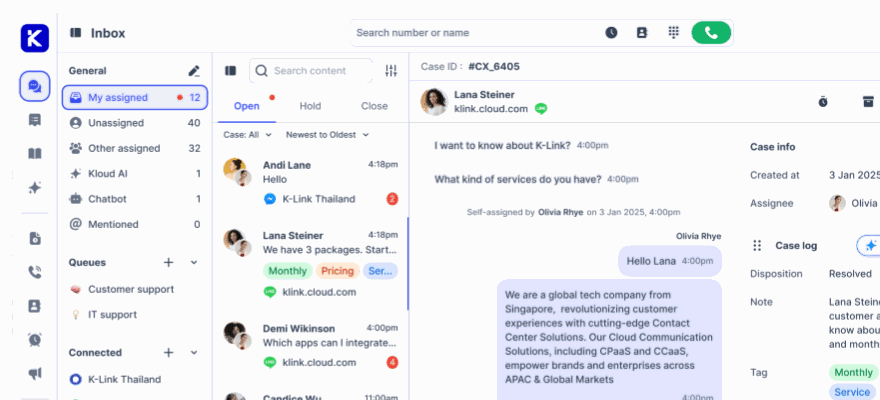
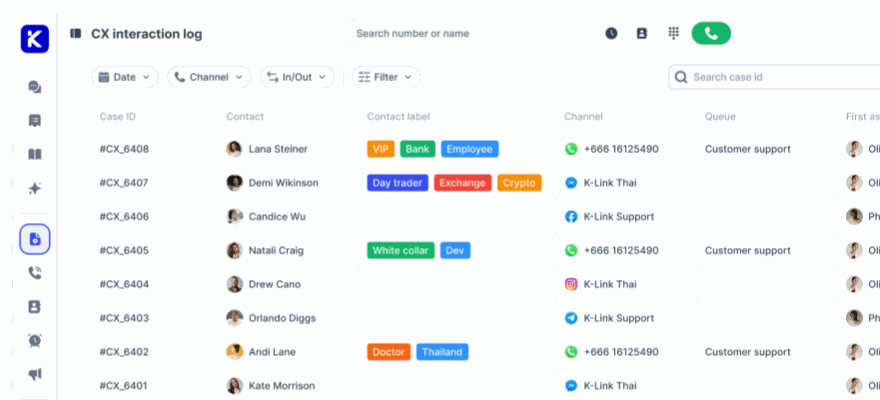
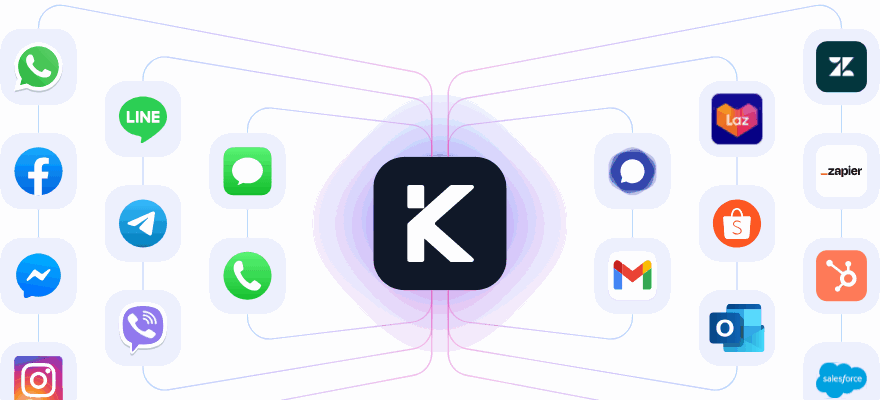
klink.cloud merges telephony (including virtual numbers and SIP trunks), social media platforms (like WhatsApp, Facebook Messenger, and Instagram), messaging apps (such as Telegram and LINE), email, and live chat into a single Unified Inbox. Agents can view and manage all customer conversations in one place, with full context and history available across channels. Whether handled by AI agents or human agents, conversations pick up right where they left off.
The platform integrates with CRMs, helpdesks, and billing systems, ensuring agents have access to details like language preferences, VIP status, purchase history, and custom fields. With this rich dataset, AI tools can make smarter routing decisions and provide more personalized responses.
"Since adopting klink.cloud, we've seen a massive improvement in our response times. Our customers are happier, and our agents are more efficient than ever."
– Sarah Lee, Head of Contact Center, Horizon Solutions
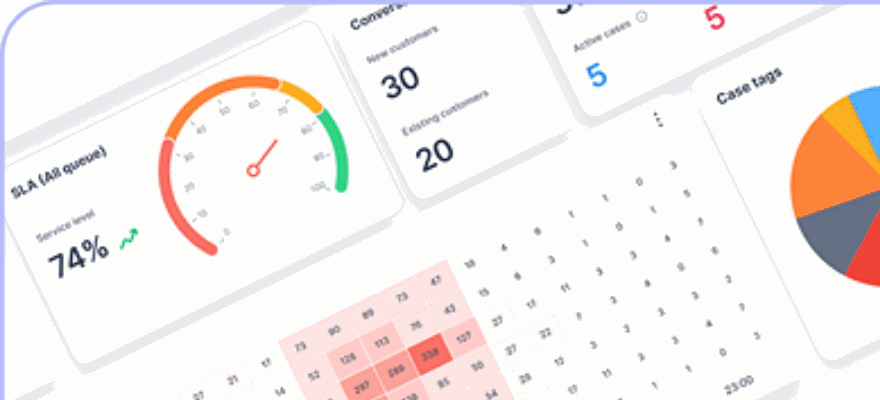
For instance, imagine a customer starts a conversation on Facebook Messenger about a billing issue and later calls in to follow up. The agent answering the call can instantly see the earlier conversation, account details, and any related tickets. AI systems also access this complete history, enabling them to suggest solutions or route the call efficiently. Case management tools track all interactions across channels, monitoring metrics like first response time, SLA compliance, resolution time, and customer sentiment - all from one dashboard.
The results speak for themselves: klink.cloud users report a 5× increase in productivity, a 2× boost in customer satisfaction, and 99% uptime for consistent, reliable service.
This unified interface sets the stage for advanced automation that optimizes operations even further.
Automated Workflows and Processes
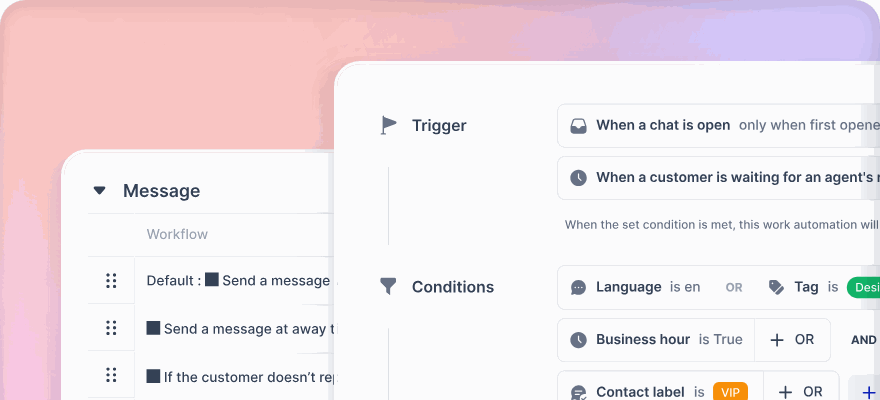
With a consolidated view of customer interactions, klink.cloud automates key tasks like ticket creation, categorization, follow-ups, and escalations. The platform can automatically generate and categorize tickets, assign tags or priorities based on intent and sentiment, trigger follow-up actions, and escalate complex cases to specialized teams. These automated workflows reduce the burden of repetitive administrative tasks, allowing agents to focus on resolving customer issues.
The platform’s intelligent call routing, combined with AI-driven intent detection, ensures customers are connected to the right resource on the first attempt. Configurable IVR menus work alongside AI tools to interpret spoken or typed intent and route interactions to the most suitable bot, queue, or human agent based on skills, availability, and customer value. This approach minimizes transfers and improves first-contact resolution.
For example, a customer calling about a password reset might be directed to an AI voicebot that handles the process without human involvement. If the same customer later calls with a complicated billing issue, the AI detects the higher priority and routes the call to a senior specialist, complete with the customer’s full interaction history.
AI chatbots and voicebots can also be integrated into klink.cloud’s messaging and telephony channels, handling FAQs, authentication, simple transactions, and status updates. When necessary, these bots escalate to human agents, ensuring seamless transitions. Within the interface, AI tools assist agents by suggesting replies, summarizing calls, and highlighting next-best actions in real time - reducing average handling times and post-call work significantly.
The platform also offers real-time analytics, providing insights into customer interactions, agent performance, and operational data across channels. Managers can monitor how many interactions are handled by bots versus humans, track key performance indicators like first-contact resolution, and identify areas where automation may require human intervention. This visibility allows for continuous fine-tuning, ensuring workflows stay safe, compliant, and aligned with business goals.
For U.S.-based organizations, klink.cloud’s browser-hosted, cloud-based architecture is especially suited for distributed or remote teams. Its flexibility makes it easy to scale, add new channels, or test AI use cases without major infrastructure changes - helping contact centers reduce costs while improving service quality.
Flexible pricing options make klink.cloud accessible to businesses of all sizes. The Free plan offers basic omnichannel capabilities, while the Starter plan ($23/user/month) adds features like virtual numbers and call management. The Growth plan ($69/user/month) includes unlimited CRM contacts, workflow automation, IVR, and rules-based routing, making it ideal for teams leveraging AI-driven automation. For organizations with complex needs, the Enterprise plan provides custom API integrations, advanced telephony features, CRM integrations (e.g., Salesforce, HubSpot), and dedicated support.
Managing AI Implementation and Measuring Results
Rolling out AI in contact centers isn't just about plugging in new technology - it requires careful planning around sensitive topics like data privacy, adapting the workforce, and consistently tracking performance. Jumping into AI without a solid governance framework or clear metrics often leads to compliance headaches, resistance from employees, and difficulty proving return on investment (ROI).
To succeed, organizations need to set clear rules for data use, prepare their teams for shifting roles, and establish precise performance metrics. With strong governance, the shift in agent responsibilities can feel like a natural evolution toward more meaningful customer interactions.
AI Governance and Compliance
Contact centers deal with sensitive customer information every day, making data privacy and regulatory compliance top priorities when introducing AI. In the U.S., companies must navigate laws like the Telephone Consumer Protection Act (TCPA), which limits automated calling and messaging, along with state-level privacy laws such as the California Consumer Privacy Act (CCPA) and the Virginia Consumer Data Protection Act (VCDPA). Healthcare contact centers must also comply with HIPAA, while financial services are governed by regulations like the GLBA.
To safeguard personally identifiable information (PII), organizations should use encryption, implement clear data retention policies, and conduct regular bias audits. Keeping thorough audit trails and documentation ensures compliance and supports the larger transformation efforts discussed throughout this article.
Bias in AI systems is another critical concern. For example, if a system trained on historical data shows a trend where Spanish-speaking customers waited longer for service, it could unintentionally perpetuate this bias. Regular audits should assess whether AI systems treat customers differently based on factors like language, location, or communication style to ensure fairness.
Setting up an AI governance committee can help organizations maintain control as automation grows. This group typically includes experts from legal, compliance, IT security, operations, and customer experience teams. They review AI use cases, monitor performance for compliance, and adjust policies as regulations change. They also ensure that AI systems have human oversight, such as requiring agent approval for certain decisions or messages.
Transparency with customers is equally important. Contact centers should clearly disclose when customers are interacting with AI instead of a human. For instance, a chatbot could introduce itself by name and explain that it’s an automated assistant, or an IVR system might state, "You're speaking with an AI voice assistant" at the beginning of a call.
Finally, documentation is essential for audits. Organizations should keep detailed records of AI training data, model versions, decision-making processes, and regular testing results to demonstrate that systems are functioning as intended.
How AI Changes Agent Responsibilities
AI transforms agent roles by taking over repetitive tasks, allowing agents to focus on more complex challenges that require problem-solving, empathy, and technical skills. This shift supports the improved customer experiences mentioned earlier.
As AI handles routine inquiries, the remaining tasks often involve more nuanced issues, such as processing refunds for damaged items, resolving billing disputes, or calming frustrated customers. This change happens gradually, giving agents time to adjust.
Training programs play a key role in helping agents adapt. These programs teach agents how to interpret AI recommendations, when to override automated suggestions, and how to provide feedback that improves AI systems over time. Instead of seeing AI as a threat, agents learn to use it as a tool that helps them work more efficiently and make better decisions.
The agent's role also becomes more consultative. For example, an agent might review an AI-generated summary of a customer’s previous interactions, identify a pattern the AI missed, and proactively resolve an issue before the customer brings it up. This level of autonomy not only improves customer satisfaction but also makes the job more rewarding for agents.
Career opportunities expand as well. Agents skilled at working with AI tools might transition into roles like AI trainer, where they review automated interactions to improve system responses, or quality assurance specialist, where they audit AI performance and identify areas for improvement. Some may even become workflow designers, using their frontline experience to configure automation rules and escalation triggers.
However, this transformation requires thoughtful change management. Organizations must clearly communicate how AI will enhance, not replace, jobs. Involving agents in AI implementation decisions and recognizing those who successfully adapt can prevent high turnover and ensure smooth adoption of the technology.
Metrics for Tracking AI Performance
To measure the impact of AI, organizations need targeted metrics that show whether automation is improving efficiency, cutting costs, and enhancing customer experiences. Generic performance indicators won’t cut it - metrics must directly tie to AI functionality.
- Automation rate: Tracks the percentage of interactions completed without human involvement. This should be broken down by channel (voice, chat, email, social media) and inquiry type, as automation rates can vary widely. For instance, password resets might achieve 95% automation, while billing disputes may only reach 30%.
- Containment rate: Focuses on self-service channels, measuring how often customers resolve their issues without escalating to a human agent. High containment rates suggest that customers trust and successfully use AI tools, while low rates may point to gaps in the system.
- First-contact resolution (FCR): Measures whether AI resolves an issue fully during the initial interaction. Comparing FCR rates across AI-only, AI-assisted, and human-only interactions can clarify where each approach works best.
- Average handling time (AHT): Typically decreases when AI assists agents by providing relevant information, suggesting responses, and automating tasks like note-taking. Tracking AHT for AI-assisted versus unassisted interactions highlights these efficiency gains. For example, if AI support reduces AHT from 12 minutes to 8 minutes for complex cases, that’s a 33% improvement.
- Customer satisfaction (CSAT): Gathering CSAT scores for both AI and human interactions ensures automation isn’t negatively impacting the customer experience. Breaking this down by interaction type helps identify which scenarios benefit most from AI.
- Cost per contact: Measures the financial impact of automation. For instance, if a human-handled phone call costs $8.50 - including wages, benefits, and overhead - but an AI-handled chat costs $0.75, the savings are clear. Multiply this by monthly volumes to project annual savings.
- Transfer rate: Tracks how often AI incorrectly handles inquiries, forcing customers to wait for a human agent. High transfer rates may indicate overly aggressive AI deployment or poor intent recognition. While some transfers are inevitable for complex issues, they should happen quickly to avoid frustrating customers.
These metrics provide a clear picture of how well AI is performing and where improvements are needed, ensuring both the technology and the workforce continue to evolve effectively.
Conclusion
AI is reshaping the way contact centers function. By automating up to 70% of repetitive, manual tasks, it allows human agents to dedicate their time to more complex problem-solving and relationship-building activities. This shift not only enhances operational efficiency but also creates a more responsive and customer-focused environment. These advancements lay the groundwork for the compelling business case that follows.
The numbers speak for themselves. Gartner projects that conversational AI will cut global agent labor costs by about $80 billion by 2026, primarily by automating high-volume tasks like password resets, order tracking, billing inquiries, and post-call documentation. Companies leveraging generative AI–enabled customer service agents are already seeing measurable results: a 14% increase in issues resolved per hour and a 9% reduction in handling time. These changes are fundamentally altering the economics of contact centers.
For customers, the benefits are clear. AI provides faster responses, 24/7 availability across multiple channels, and more accurate, consistent answers. Whether it’s routing customers to the right resource on the first try or solving common issues in seconds, AI enhances satisfaction, improves first-contact resolution, and reduces wait times - key factors that drive loyalty and retention.
Operationally, AI introduces capabilities that were once out of reach with manual processes. Predictive analytics enable proactive outreach, while AI-optimized routing connects customers to the best resource based on their intent, sentiment, and history. Real-time tools like agent-assist features - offering knowledge suggestions, drafting responses, and summarizing conversations - lighten the cognitive load on agents, allowing them to focus on delivering better service. These advancements streamline operations while empowering agents to excel in high-value, complex interactions.
As AI takes over routine tasks, the role of contact center agents is evolving. Agents are now better positioned to handle emotionally charged situations, unique exceptions, and high-value conversations requiring empathy and judgment. In fact, 61% of contact centers report that AI handling simpler tasks has allowed agents to focus on more emotionally intense, high-stakes interactions. This shift not only makes the role more engaging but also opens doors to new career opportunities in areas like AI training, quality assurance, and workflow design.
Platforms like klink.cloud make this transformation both achievable and scalable. By integrating AI-driven automation with human expertise, klink.cloud orchestrates interactions across voice, chat, email, and social channels from a single dashboard. It consolidates data and provides real-time analytics, simplifying operations and accelerating results. This unified approach ensures that as AI applications grow, your operations remain coordinated and compliant.
The momentum behind AI in contact centers is undeniable. By 2026, fully automated AI interactions are expected to make up 10% of all customer service engagements, a sharp rise from just 1.6% in 2022. Early adopters will set new standards for speed, personalization, and consistency. Starting with high-volume, low-complexity tasks, building AI-assisted workflows, and maintaining clear governance can help businesses stay ahead. With the right platform and strategy, the future - where AI takes care of routine work and humans focus on delivering exceptional experiences - is already within reach.
FAQs
How does AI help contact centers maintain data privacy and comply with regulations like CCPA and HIPAA?
AI plays a pivotal role in helping contact centers safeguard data privacy and adhere to regulations like CCPA and HIPAA. It continuously monitors interactions to ensure compliance, flagging any instances where sensitive information might be improperly shared. This proactive approach allows for immediate action to protect customer data and uphold privacy standards.
On top of that, AI-powered tools are equipped to detect fraudulent activities and secure sensitive information in real time. This reduces the likelihood of data breaches significantly. By automating these critical processes, businesses not only stay compliant but also free up resources to focus on enhancing the customer experience.
What new career opportunities could emerge for contact center agents as AI handles repetitive tasks?
As AI takes over repetitive tasks, contact center agents have the chance to step into more specialized and impactful roles. For instance, they can transition into customer experience specialists, concentrating on crafting personalized and meaningful interactions. Others might excel as problem resolution experts, addressing intricate issues that call for human creativity and empathy. Another promising path is becoming customer success advisors, where the focus shifts to guiding clients toward their goals and building lasting relationships.
These evolving roles highlight the importance of skills like emotional intelligence, critical thinking, and adaptability. By leveraging these abilities, agents can provide more valuable contributions and elevate the overall customer experience.
How can businesses evaluate the success of AI in contact centers to ensure it delivers a strong ROI?
To gauge how well AI is performing in contact centers and to ensure it's delivering a solid return on investment, businesses can focus on tracking key metrics such as Automated Resolution Rate (ARR), First Contact Resolution (FCR), Customer Satisfaction Score (CSAT), Average Handling Time (AHT), and Customer Effort Score (CES). These measurements offer a clear picture of how AI is improving workflows and enhancing the overall customer experience.
Beyond these, keeping an eye on AI's influence on call volumes, response times, and agent productivity can reveal opportunities for further refinement. By regularly analyzing these data points, companies can make adjustments to their AI systems, ensuring they operate as efficiently as possible while delivering meaningful benefits to both customers and support teams.