The best contact center software in Southeast Asia
The best contact center software in Southeast Asia is the one that answers the channels your customers actually use, prices in a way that survives your headcount, and puts voice and chat on the same clock. For most teams in this region the shortlist comes down to seven platforms, and which one wins turns on a single question: are you buying seats, or are you buying resolutions?
This is written for the teams we work with every day, which are contact centers and CX teams running high volumes of calls and chat at once: banks, insurers, hospital groups, utilities, retailers and the BPOs who serve them. If that is you, the criteria below matter more than any feature grid.
Why the Southeast Asian shortlist is different
Most contact center software is designed for a North American or European buyer, and four assumptions built into it break the moment you operate here.
The channel mix is not the same
In Thailand the conversation happens on LINE. In Myanmar and parts of the region it is Viber. Across the whole of Southeast Asia it is WhatsApp, Messenger and Instagram, and for anyone selling online it is also Lazada, Shopee and TikTok Shop. A platform that treats messaging as a bolt on beside a ticket queue will do the most important part of your job worst.
This is not a preference, it is where the volume is. On one of the banks we work with, 8 in 10 conversations arrive on WhatsApp. On another, two thirds still arrive by phone. Both numbers are true at the same time in the same region, which is the argument for one platform that carries voice and messaging rather than a best of breed tool for each.
Per seat pricing is imported from a market with different salaries
This is the one that decides most enterprise deals here, and it is rarely said out loud. A platform priced at $115 to $155 per named agent per month was designed for a market where an agent costs several times what an agent costs in Bangkok, Yangon, Manila or Ho Chi Minh City. Applied to a 200 seat operation in Southeast Asia, the software starts to rival the salaries, and every person you add makes it worse.
It also creates the wrong incentive. When each seat has a price, teams ration logins, share accounts, and keep supervisors and back office staff out of the system, which is exactly how you lose the reporting you bought the platform for.
Numbers and regulation are local
A contact center needs local caller ID, and getting a number in this region means an activation form and a regulator rather than a checkout. Some markets take a day, some take two weeks, and some require you to keep your existing carrier. Any platform you consider has to support bringing your own carrier or SIP trunk, because for many teams here the telco relationship is not negotiable.
Regulated buyers cannot always use the public cloud
Banks, insurers, hospital groups and anything touching government procurement will ask where the data sits and whether the platform can be deployed privately. If the answer is a single multi tenant cloud in another hemisphere, the evaluation ends there, whatever the product does.
The seven platforms worth comparing
Prices below are list prices as published by each vendor in August 2026, and each links to the full comparison with a calculator. Treat them as a snapshot: vendor pricing changes, and the figure you are quoted may differ.
| Platform | Priced by | Voice included | Strongest for |
|---|---|---|---|
| klink.cloud | Resolved conversation. $99 a month including 1,000, unlimited users | Yes | Voice plus messaging at volume in this region, with private deployment available |
| Genesys | Named agent, listed at $155 a month | Yes | Very large enterprises with workforce management and years of process built in |
| Zendesk | Agent. Suite Professional $115, Talk $19, AI add on $50, plus $2 per AI resolution | Add on | Mature ticketing and a large app marketplace |
| Freshworks | Agent, three times over. Freshdesk $49, Freshchat $29, Freshcaller $19 | Separate product | Teams that want a familiar suite and will pay per product |
| Intercom | Seat $85, Copilot $29 per seat, Fin $0.99 per resolution | Per minute on top | Product led SaaS support, strong in app messaging |
| Gorgias | Ticket allowance with overage, plus $0.90 per AI resolution | Add on | Small and mid sized ecommerce on Shopify |
| respond.io | $159 a month, then $20 per user past ten and $12 per 100 monthly active contacts | Via a VoIP integration | Messaging first teams running click to chat campaigns |
There are also regional messaging first tools that come up in Thai and Indonesian shortlists. They are genuinely good at WhatsApp and LINE, and the question to ask them is what happens to your phone queue, your recordings and your service level reporting, because that is usually where a messaging tool stops.
How to actually choose
Ignore feature counts. Every platform on that list has hundreds of features and you will use forty. These are the six questions that decide whether the thing works for a high volume operation.
1. Do voice and chat share one clock?
If your phone system and your chat tool are different products, you have two service levels, two sets of reports, and no honest answer to how long a customer waited. Ask to see one customer who called on Monday and messaged on Wednesday, on one timeline, in one case, with one first response time. Most demos will show you two screens.
2. What happens to the bill when you add ten people?
Run the arithmetic at your real headcount rather than the demo's. Per seat platforms are cheapest in the pilot and most expensive in production, which is the opposite of the shape you want. Ask what a seasonal peak does, and what happens when your BPO partner needs twenty temporary agents for a campaign.
3. Can a supervisor see the floor right now?
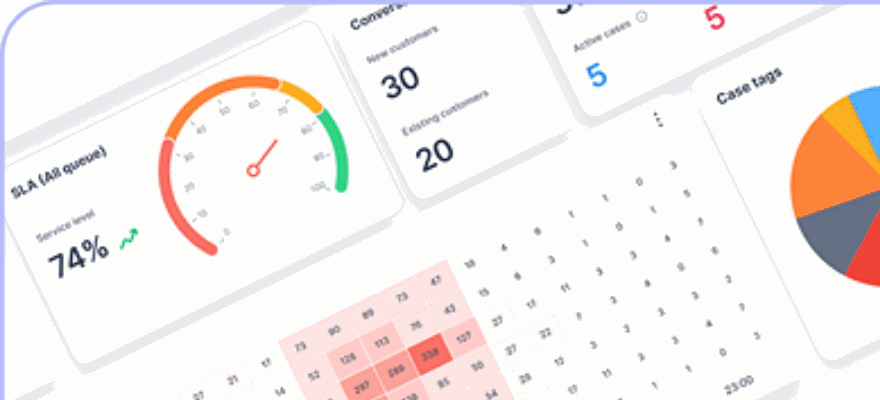
At volume, supervision is the product. You need a live board of who is available, away or on do not disturb, queue wait times as they happen, and an abandoned call report that names exactly which callers reached a queue and never got an agent. Retrospective reporting alone is not supervision.
4. Does the AI resolve, or only deflect?
The useful test is whether the agent can reach your systems mid conversation. Answering from a help article is deflection. Checking a live order, starting a return, confirming a policy status or booking an appointment is resolution, and the difference shows up in your handled volume rather than in a demo.
The second test is the handover. When the AI reaches its limit, the customer should arrive at a person with the whole thread attached, not be asked to start again. Ask to see the handover, not the happy path.
5. Where does it run, and who can see the recordings?
For regulated buyers: ask for the certification, the deployment options and the retention controls in the same breath. Recording retention should be a window you configure and permissions you set, not a fixed policy you inherit. If the vendor cannot say where data sits, procurement will find out later and it will be worse.
6. Can it answer in the language the customer wrote in?
Language routing, not language support. A platform "supporting Thai" often means the interface is translated. What a bilingual operation needs is a conversation routed to a queue of people who can answer in that language, without a transfer while someone hunts for a speaker.
Where klink.cloud fits, and where it does not
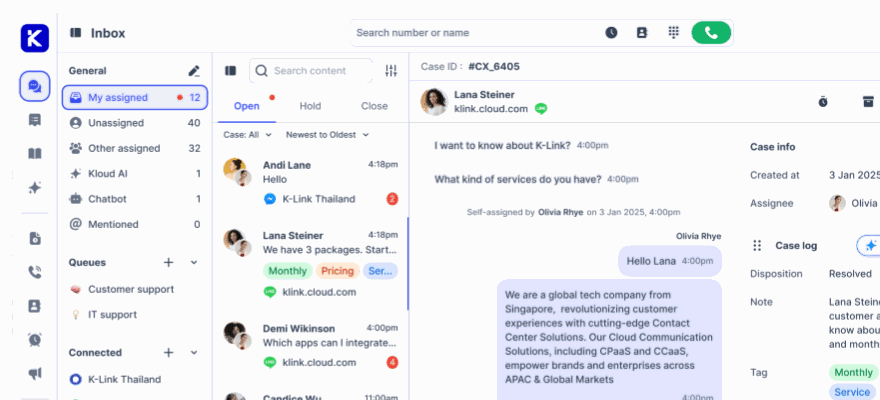
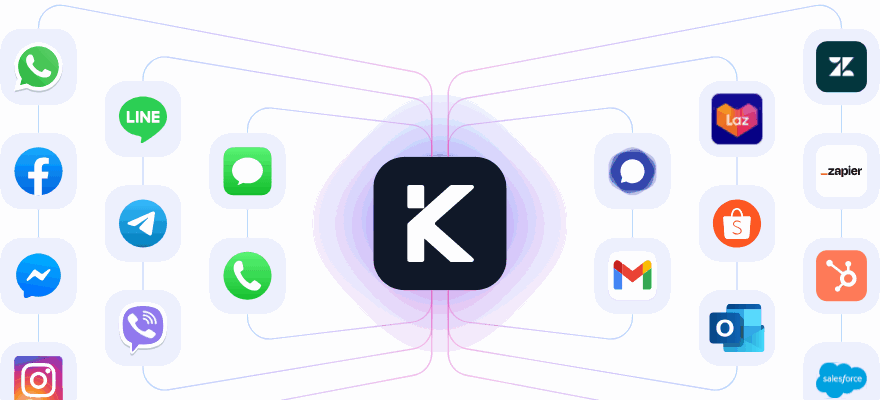
We build klink.cloud, so read this section with that in mind. It is on the list because it was built for this region, not localised into it: LINE, Viber, WhatsApp, Messenger, Instagram, Telegram, Lazada, Shopee, web chat, email and telephony in one queue, served from the nearest AWS local zone so APAC traffic stays in APAC, with private cloud and on premise deployment for buyers who need it.
The commercial difference is the one worth understanding. Users are unlimited on every plan and the meter is a resolved conversation: $0.20 pay as you go, or $99 a month including 1,000 on the Growth plan. Adding an agent, a supervisor or a whole BPO team for a campaign does not change the bill. Telephony is part of the platform rather than an add on, and bringing your own carrier keeps your existing numbers and rates.
What that has produced on live deployments, in figures those customers have published: a median first response of 13 seconds across every channel at one bank, 16 seconds at another, 99% of rated conversations ending satisfied, and around 80% of repetitive volume resolved without a person.
Where it is not the right answer. If you handle a few hundred tickets a month on Shopify and want nothing to do with voice, Gorgias at $60 for 300 tickets undercuts a $99 flat plan, and our own comparison page says so. If you are a very large enterprise whose requirement list is led by workforce management, outbound campaign dialling at scale and a decade of embedded process, Genesys has depth there that we do not claim to match. And if your team lives entirely inside a product and never picks up a phone, an in app messaging specialist may simply fit better.
Common questions
What is the difference between contact center software and help desk software?
A help desk manages tickets, usually from email and chat. Contact center software adds the phone: queues, IVR, recording, call detail records and the service levels that go with them. Teams that buy a help desk first and add voice later end up with two systems and two versions of the truth, which is the most common reason they are here reading this.
How much does contact center software cost in Southeast Asia?
Per seat, it depends how much of the stack you buy. Ticketing alone starts around $49 per agent per month on Freshdesk Pro. A full Freshworks stack of ticketing, chat and voice is $97 per agent. Genesys lists $155 per named agent. A Zendesk stack of Suite Professional, Talk and the AI add on is $184 per agent, and then $2 for every AI resolution on top. None of those figures include voice usage.
Per resolution pricing works differently: klink.cloud is $0.20 per resolved conversation, or $99 a month including 1,000, with unlimited users either way. The gap between the two models widens with every person you add, which is why the arithmetic is worth doing at your real headcount rather than on a vendor's example.
Can we keep our existing phone numbers and carrier?
On klink.cloud, yes. Bring your own carrier connects your existing numbers, PBX or SIP trunk and is billed on concurrent calls from $50 a month for ten, so your telco keeps billing traffic as it does today. Ask every vendor on your shortlist this question early, because in this region the answer often decides the project.
What does a resolved conversation mean?
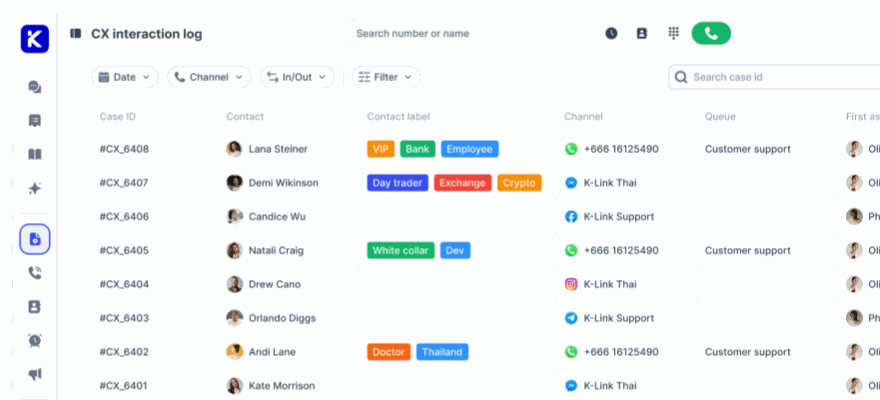
One customer session, however many messages it contains and whichever channel it arrives on, closed with a case number you can find again in the CX log. It is a unit of work rather than a unit of headcount, which is the whole point: automating more of your support lowers the bill instead of leaving you paying for seats you no longer need.
The short version
If you run high volumes of calls and chat in Southeast Asia, choose on four things: the channels your customers really use, whether voice and chat share one clock, what the bill does as the team grows, and whether the platform can be deployed where your regulator will allow it. Feature lists will not separate these platforms. Those four questions will.
Two companion pieces go deeper: what breaks when a contact center passes 200 agents, and the RFP checklist for putting these questions to every vendor in writing.
If you want to see it against your own queues rather than a demo dataset, book thirty minutes and bring your busiest hour. Or read how the in-house contact center is put together, what runs in the omnichannel inbox, and what the pricing looks like at your volume.