What breaks when a contact center passes 200 agents
What breaks in a large contact center is almost never throughput. The software keeps handling the calls. What stops working, usually within the same quarter, is the licence model, the routing model, supervision and the reporting. Each was fine at 40 agents and each fails for a different reason somewhere between 150 and 300.
This is the pattern we see in enterprise deployments: banks, insurers, utilities, hospital groups and the BPOs who serve them. If you are approaching that size, these are the four to plan for.
1. The seat licence stops being a line item and becomes the strategy
At 40 agents a per seat platform is an expense. At 250 it is a constraint on how you run the operation, and you can see it in the decisions teams start making.
Supervisors get left out of the system to save licences, so they manage from exports. Back office staff who resolve half the escalations never get accounts, so their work happens in email and disappears from the case. Seasonal peaks get staffed by people sharing logins, which destroys the agent level reporting you bought the platform for. A BPO partner who could take twenty seats for a campaign does not, because the seats cost more than the campaign earns.
None of that is a software limitation. It is the pricing model shaping the operation, and it is worth naming during procurement rather than discovering in year two. The question to ask any vendor is not the per seat price. It is what your bill does when you add ten people for six weeks.
2. Round robin routing quietly stops being fair
Small teams route by availability and it works, because everyone can handle everything. Past a certain size the assumption fails: agents specialise, languages differ, queues have different service levels, and the cost of putting a conversation in front of the wrong person rises sharply.
Three controls matter at this size, and most teams discover them in the wrong order.
- Distribution strategy. Round robin, fewest assignments or random are genuinely different at volume. Fewest assignments protects your fastest people from being buried by their own speed, which round robin does not.
- Capacity, per agent and globally. A cap per queue is not enough once an agent belongs to several. What you need is one global capacity per person, so someone in four queues cannot be handed four times the work.
- Language and skill queues. Routing to a queue of people who can answer in that language, rather than transferring while somebody hunts for a speaker. In a bilingual or trilingual operation this is the single biggest lever on first response time.
The failure mode is subtle: nothing alerts you. Average handling time drifts up, the fast agents burn out, and the cause looks like a people problem rather than a routing problem.
3. You can no longer see the floor
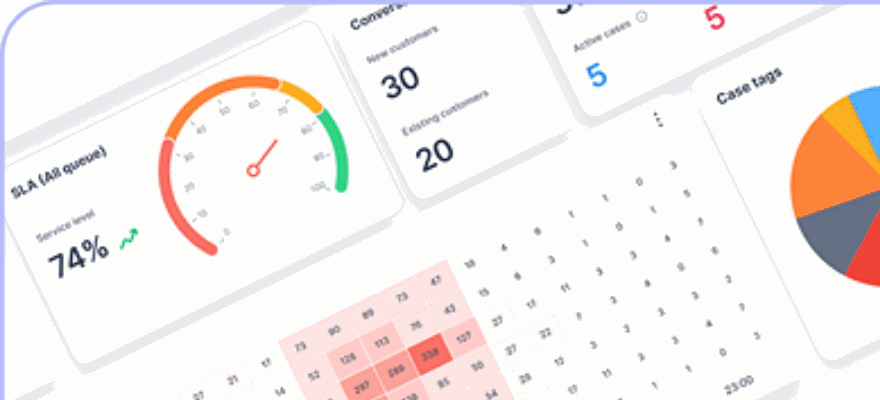
A supervisor with 15 agents manages by looking up. A supervisor with 200 manages by dashboard, and if the dashboard is retrospective they are always managing yesterday.
What is needed at this size is live: a board showing who is available, away or on do not disturb, queue wait times updating as they happen, and an abandoned call report that names exactly which callers reached a queue and never reached an agent, with the abandon rate per queue. An agent status log with reasons and timestamps turns availability from an argument into a record.
The number that matters most here is the one most platforms make hardest to get: not how many calls you handled, but how many people gave up. Abandonment is where a large contact center loses customers silently, and it is invisible in any report built only from handled contacts.
4. Two systems means nobody agrees on a number
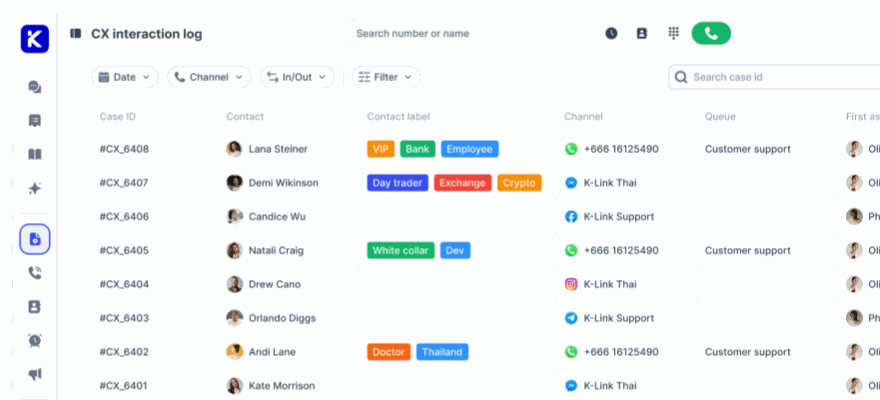
Almost every contact center at this size arrived by accumulation: a PBX, a chat tool, a ticket system, and a spreadsheet holding them together. Each was the right decision at the time. Together they make an honest service level impossible.
The tell is a meeting where two reports disagree and nobody can say which is right, because voice measures first response from ring and chat measures it from assignment, and neither knows your business hours. You end up defending the report instead of running the operation.
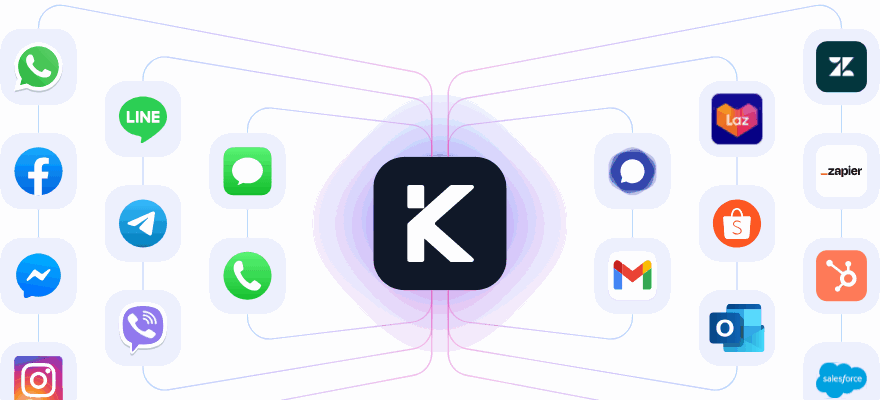
Getting to one number means voice and messaging in the same case, on the same SLA clock, with the same dispositions and business hours applied. That is a platform decision rather than a reporting decision, which is why it is very hard to fix later without a migration.
The related one: quality assurance stops scaling by sampling
At 200 seats, listening to a handful of calls a week tells you nothing statistically. Recording with transcription attached to the case makes conversations searchable rather than sampled, dispositions turn complaint volume into a number instead of a feeling, and CSAT triggered by disposition tells you satisfaction per issue type rather than one blended score that hides everything interesting.
What to fix, and roughly when
| Roughly | What starts hurting | What to put in place |
|---|---|---|
| 50 agents | Work lands unevenly, fast agents absorb it | Distribution strategy and a capacity cap per agent |
| 100 agents | Escalations disappear into email | Back office tickets with an owner and a clock, roles and permissions |
| 200 agents | Supervisors manage from yesterday's export | Live status board, queue wait times, abandoned call report |
| 200 agents | Per seat licensing starts shaping decisions | Price the next 12 months at real headcount, including peaks |
| 300 and up | No two reports agree | Voice and messaging on one SLA clock, business hours applied |
| Any size, if regulated | Procurement asks where the data sits | Retention windows you configure, private or on premise deployment |
The one that is not on the list
Headcount is usually the first answer to volume and the worst one available. Most of what a large contact center handles is a small number of questions asked many times: order status, balance, appointment, policy status, where is my delivery. An AI agent that can reach your systems mid conversation resolves those end to end rather than deflecting them into a help article, and on live deployments around 80% of that repetitive volume is resolved without a person.
The part that matters at enterprise scale is the handover. When the AI reaches its limit the customer should arrive at an agent with the whole thread attached and the identity check already done, not be asked to start again. That single behaviour is the difference between automation your customers tolerate and automation they complain about.
Common questions
Does klink.cloud charge per agent?
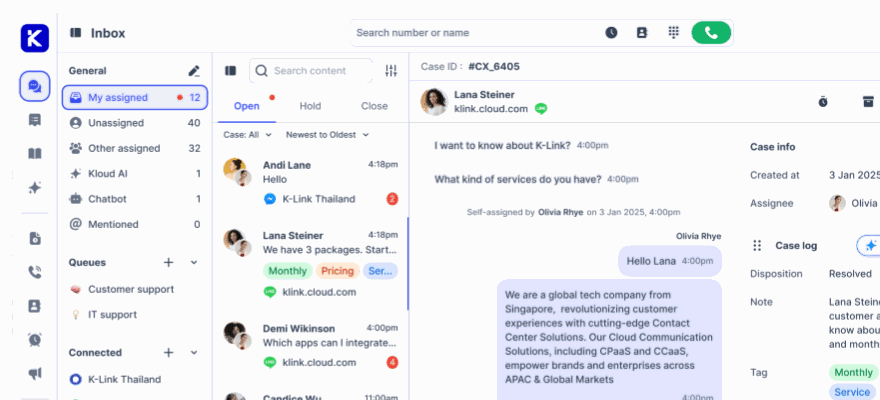
No. Users are unlimited on every plan and the meter is a resolved conversation, so supervisors, back office staff and a BPO team taking a campaign all get accounts without changing the bill. That is the practical answer to the first problem on this page.
Can we keep our existing PBX or SIP trunk at this size?
Yes. Bring your own carrier connects existing numbers, a PBX or a SIP trunk and is billed on concurrent calls from $50 a month for ten, so your telco relationship and your rates stay as they are. For large operations this usually decides the migration plan, because numbers do not have to move on day one.
What about deployment for a regulated operation?
The platform is ISO 27001 certified and hosted on AWS, with single sign on and role based access across analytics, contacts, tickets, inbox, CX logs and reports. Private cloud and on premise deployment are available where a regulator or a contract requires it, and recording retention is a window you configure rather than one you inherit.
Where to start
If you are approaching this size, the useful exercise is not a feature comparison. Take your busiest hour from last month, and ask any platform you are evaluating to show you that hour: who was available, how long people waited, how many gave up, and what the service level actually was across voice and chat together. Most evaluations never ask, and it is the only question whose answer changes at 200 seats.
If you are running a formal evaluation, the RFP checklist turns all of this into requirements, and the regional comparison covers how the main platforms price at this size.
We will do that with your own numbers in a thirty minute session. Or read how the in-house contact center handles routing and supervision, what inbound service at high volume looks like, and how multi client BPO operations keep queues and reporting separate.