What is case management in a contact center
Ask a contact center manager how many conversations the team handled last week and the answer arrives in seconds. Ask what happened on one of them, the complaint that was escalated on Tuesday afternoon, and the answer takes a day. Somebody has to remember who took the call, find the recording if there is one, check whether an email went out afterwards, and ask the agent what they said. By then the customer has called twice more and told a different version each time.
That gap is what case management closes. It is not a reporting feature and it is not a ticketing system with a new label. It is the decision that every interaction becomes a record you can open, quote and settle an argument with.
A case, defined
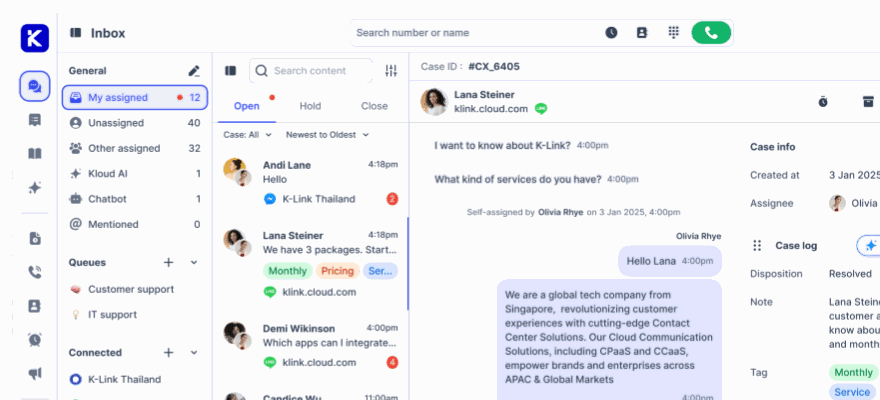
A case is the record of one interaction between a customer and your team, from the moment it arrives to the moment somebody closes it. A phone call is a case. A WhatsApp thread is a case. An email and a live chat session are cases. They are the same kind of object, which is the whole point: if voice and messaging are different records in different systems, no report can honestly add them together.
A case that is worth keeping answers six questions without anybody being asked.
| The question | What the case has to record |
|---|---|
| Who was it | The contact, and the label on that contact, so a VIP or a support tier is visible in the list rather than looked up |
| Where did it arrive | Channel, queue and direction, which separates customer demand from your own outreach |
| Who handled it | First assignee, current assignee and who closed it, because after a transfer those are three different people |
| How long did it take | The timings, of which there are more than one and more than two |
| How did it end | Disposition, type, category, sub category and tags, set on a wrap up form rather than inferred later |
| What was actually said | The recording, the transcript and the message history, attached to the case rather than stored somewhere else |
Most platforms give you three or four of those. The missing ones are always the same: the timings collapse into one number, and the evidence lives in a different product from the metrics.
A case is not a ticket, and an operation needs both
The words get used interchangeably and they are not the same thing. A ticket is a unit of work somebody has to do. A case is the record of an interaction that already happened.
A customer calls about a refund. That call is a case: it has a start time, a queue, an agent, a duration and a recording. The refund itself is work for the back office, which is a ticket with an owner and a clock of its own. Treat them as one object and you get the failure most teams live with: either the call disappears the moment the ticket is created, so nobody can hear what was promised, or the back office work never gets a record at all and happens in somebody's email.
The practical test is what happens to the second call. When the customer rings back on Thursday, the agent who picks up should see the Tuesday case with its transcript and its note, and the open ticket with its status, on the same contact. If those two things live in systems that do not know about each other, your agent is going to ask the customer to explain it again.
The timings, and why there are seven of them
One duration per case is the single most common shortcut, and it is the reason handling time arguments never resolve. A case that took two hours because your team was working on it for two hours and a case that took two hours because it sat on hold waiting for a bank approval are not the same case, and one number cannot tell them apart.
Seven timings, split into pairs that mean different things:
- Total hold duration. How long the case sat in pause mode waiting on information or an approval. This is the number that explains the others.
- Handled time and full handled time. Handled time excludes hold, so it measures your team's effort. Full handled time runs from creation to close including hold, so it measures what the customer experienced. A large gap between the pair is a case that spent its life waiting on somebody else, usually somebody outside the contact center.
- Resolution time and full resolution time. The same split applied to the outcome rather than the handling.
- First response time. How long the customer waited for the first reply after the case was created. On messaging this is the number customers judge you on, and it is the one most often measured from the wrong event.
- Wrap up duration. Time spent on notes, tagging and logging after the contact ended. Recorded as a number of its own, because it is real work and it is invisible in every other metric.
Keeping effort and elapsed time apart changes what you can do with the data. When full handled time rises and handled time does not, the fix is not agent coaching. It is whatever is on the other end of the hold.
Outcomes have to be chosen, not typed
The wrap up form is what turns a conversation into something reportable, and it is where most case data dies. If the outcome is a free text note, your complaint volume is a feeling rather than a number.
What makes it survive contact with a busy floor is a short list of dispositions such as resolved, follow up, transfer or escalated, a type and category structure that is yours rather than the vendor's, and tags for the topic or the action needed. Notes and tags taken during the contact should already be in the form when it opens, the timer should be set by an admin rather than by the agent, and the form should auto save while it is being filled, because the next contact does not wait. We wrote about the disposition list itself in understanding call disposition, and about the form in the post call wrap up form.
One rule is worth stating plainly: if a disposition is never used, delete it, and if two of them mean the same thing to different agents, you have one disposition with two spellings and your reports are already wrong.
Evidence is the part that gets dropped
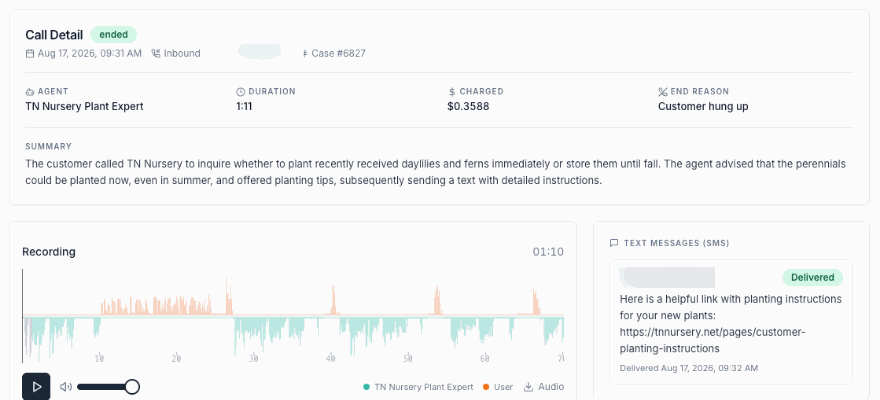
Metrics without evidence produce meetings where two people disagree about a conversation neither of them can hear. A case should keep the recording where there was a call, a timestamped transcript and a written summary alongside it, and the full message history for chat, email and social, exactly as it was sent.
This is what makes quality assurance stop being a sampling exercise. Searchable transcripts mean you can find every case where a customer mentioned a competitor, or a cancellation, or a specific product fault, instead of listening to five calls a week and hoping they were representative. It is also the only honest way to settle a dispute, internally or with a customer.
Quality belongs on the case, not in a separate report
Three fields turn a case log into something a CX lead can manage from: sentiment, CSAT and SLA status.
Sentiment is the emotional tone of the interaction. CSAT is satisfaction on the usual five point scale, and it does not have to come from a survey: AI CSAT reads the conversation when the room closes and scores it, which means a score exists on conversations no customer would ever have rated. SLA is a meet or unmeet against your own first response and resolution targets for that case, which is only meaningful if the targets are set per priority and counted inside business hours.
Both of those deserve their own treatment, and they have it: setting SLA targets that survive a bad week and measuring CSAT when almost nobody answers the survey.
If the AI answered, it is still a case
Most contact centers are now running some share of their volume through an AI agent, and the reporting usually splits in two: a dashboard for the bot and a dashboard for the humans. That split is where trust in the numbers goes.
A conversation an AI agent handled should carry the same case ID, the same timings, the same disposition and the same transcript as one your team handled. Then the AI against human resolution split is counted from rows a supervisor can open and read, rather than from a vendor's own definition of a resolution. It also means the handover is auditable: when the AI reaches its limit and passes the customer to a person, that is one case with two assignees, not two unrelated records.
Five questions to run against last week
You do not need a project to find out whether your case management works. Take last week and try to answer these.
- Pick one case ID and open it. Can you see who touched it, in order, with times?
- How many cases sat on hold for more than half their life, and what were they waiting for?
- What were the top five dispositions, and does the fifth one still mean anything?
- Which agent closed the most cases marked escalated, and can you read one of them?
- Across voice and messaging together, what share met your first response target? Not per channel. Together.
The last one is usually where it stops, because voice and messaging measure first response from different events and neither knows your business hours. That is a platform decision rather than a reporting decision, which is why it is very hard to fix after the fact.
Common questions
What counts as a case?
Every interaction between a customer and your team on any connected channel. A call, a WhatsApp thread, an email and a live chat each get their own case ID and land in the same log, rather than in a separate report per channel. Cases raised by the same contact stay attached to that contact, so a history is one lookup instead of four.
Is case management the same as a CRM?
No, and they work best pointed at each other. A CRM holds the customer: the account, the deals, the lifecycle. Case management holds what happened when that customer contacted you, at the granularity of a single conversation. A webhook pushing closed cases into the CRM gives sales the context, and gives support the account history, without either system pretending to be the other.
Do we need this if we already have call recording?
Recording is evidence without structure. It tells you what was said on the calls you think to listen to, and nothing about chat, email or social, and nothing you can count. Case management is what makes recordings findable: search a case ID, filter by disposition, then listen. On its own, a recording archive is a compliance obligation rather than an operational tool.
How do we get the data out?
A case log is worth much less if it is a walled garden. Any filtered view should export to CSV or XLSX with a column picker, so you decide whether the file carries transcripts and recordings or only the metrics, and webhooks should push case data to a CRM or a warehouse as it happens. Ask any vendor to show you the export before you sign, not after.
Where to start
If you are evaluating platforms, the useful exercise is not a feature list. Ask to be shown one case, end to end, on the demo tenant: the ID, the queue, every assignee, all of the timings, the disposition, and the recording playing from inside the record. Then ask for that same view exported to a spreadsheet. Most evaluations never ask, and it is the question whose answer varies most between vendors.
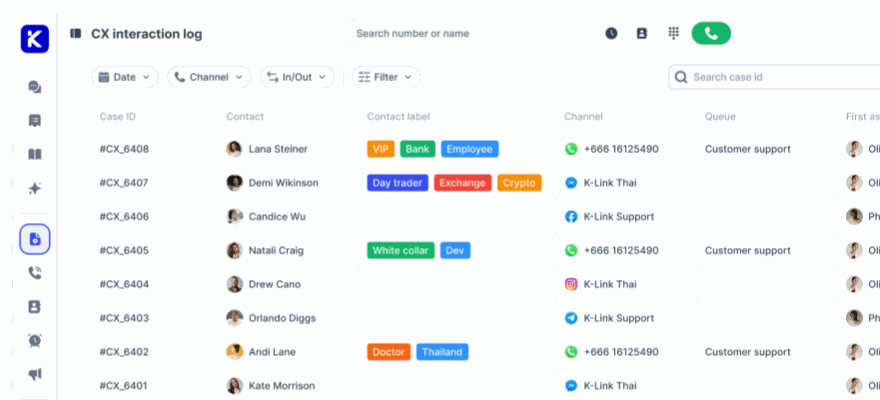
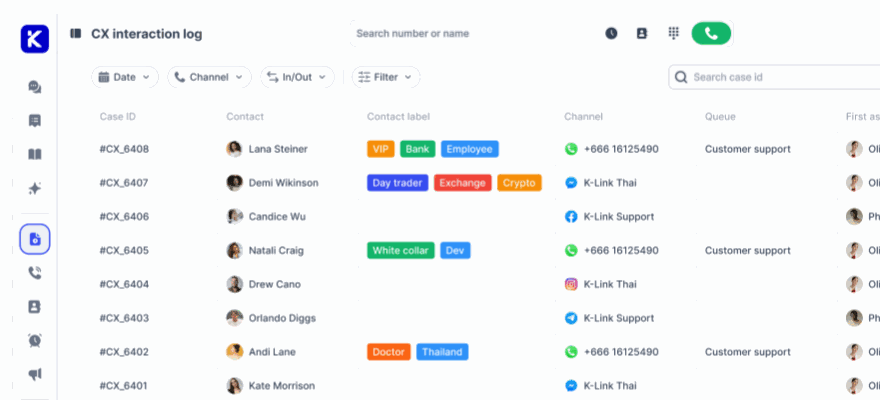
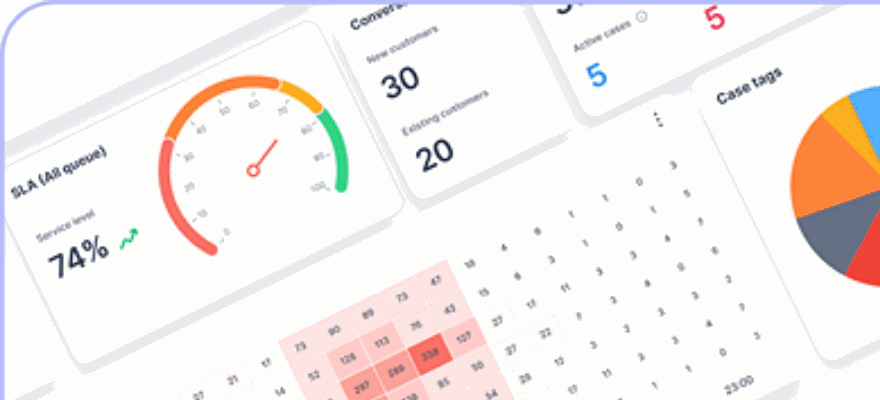
On our side, case management is the CX interaction log: 28 fields from case ID to SLA status, filtered by date, channel and direction, searchable by case ID, with the transcript attached and the columns you choose. Reporting and CX log covers the dashboards built over that data, and the contact center page covers the routing and supervision around it.
If you would rather see it against your own operation, book a thirty minute session and bring last week's hardest case. Related reading: what breaks past 200 agents and the contact center RFP checklist.